
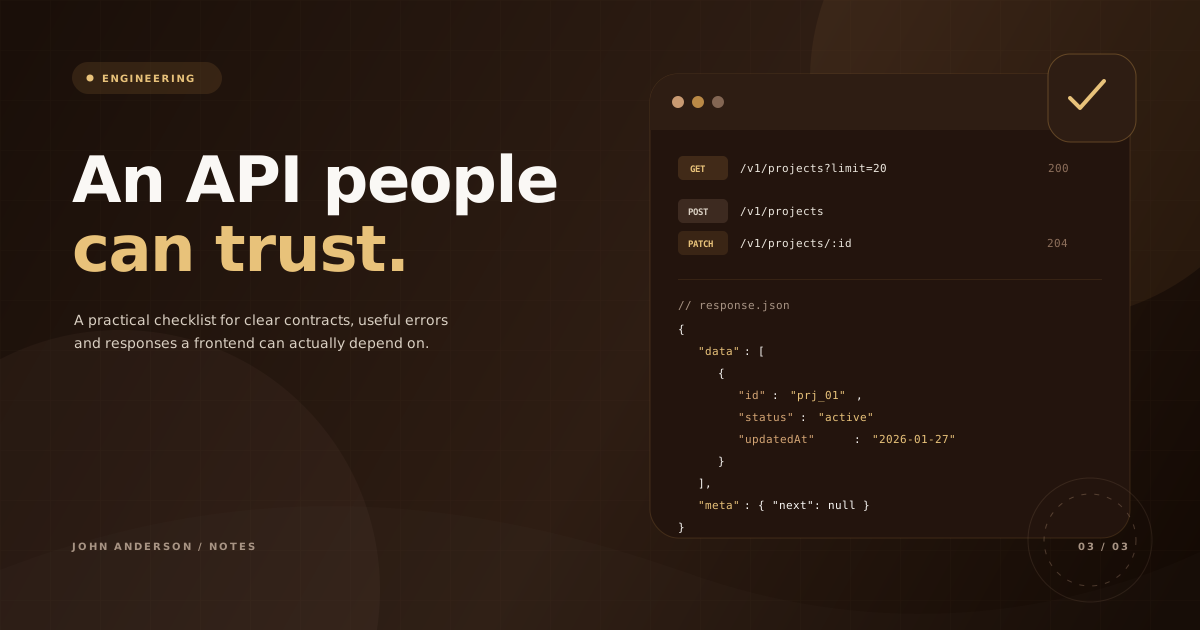
Good APIs are not just consistent. They make the next decision obvious. This is the short checklist I run through before an API becomes something other people have to live with.
Name things from the consumer's side
An endpoint should describe the resource or action the consumer is asking for, not the internal table or service that happens to support it. If a frontend developer has to read backend code to guess the shape of a response, the naming has not finished its job.
Make errors part of the contract
Success responses get designed. Errors often do not. A useful error has a stable machine-readable code, a human-readable message and enough context to fix the request. The same shape should apply across endpoints so the client can handle errors once.
{
  "error": {
    "code": "validation_error",
    "message": "The email address is not valid.",
    "field": "email"
  }
}
Design for partial failure
A page often needs more than one resource. Decide whether the client should compose requests or whether a small, explicit aggregate endpoint is worth it. Whichever you choose, make loading, empty and degraded states easy to represent. An API that only models the happy path pushes complexity into every consumer.
- Use stable identifiers and predictable collection shapes.
- Keep pagination, filtering and sorting consistent across resources.
- Validate input at the boundary and return useful messages.
- Version deliberately, or design changes that do not break clients.
- Document an example request and response for every endpoint.
Leave a trail for the next reader
A short README with a request example, a response example and the decisions behind a non-obvious field is worth more than a large generated reference nobody reads. Write down why the API works the way it does. The next person will need that context more than another endpoint.
The measure of an API is not how much it exposes. It is how confidently someone else can use it.
A working principle
The checklist is intentionally small. An API can be clever and still be hard to use. The goal is the opposite: a contract that feels obvious, behaves predictably and makes the product around it easier to build.