
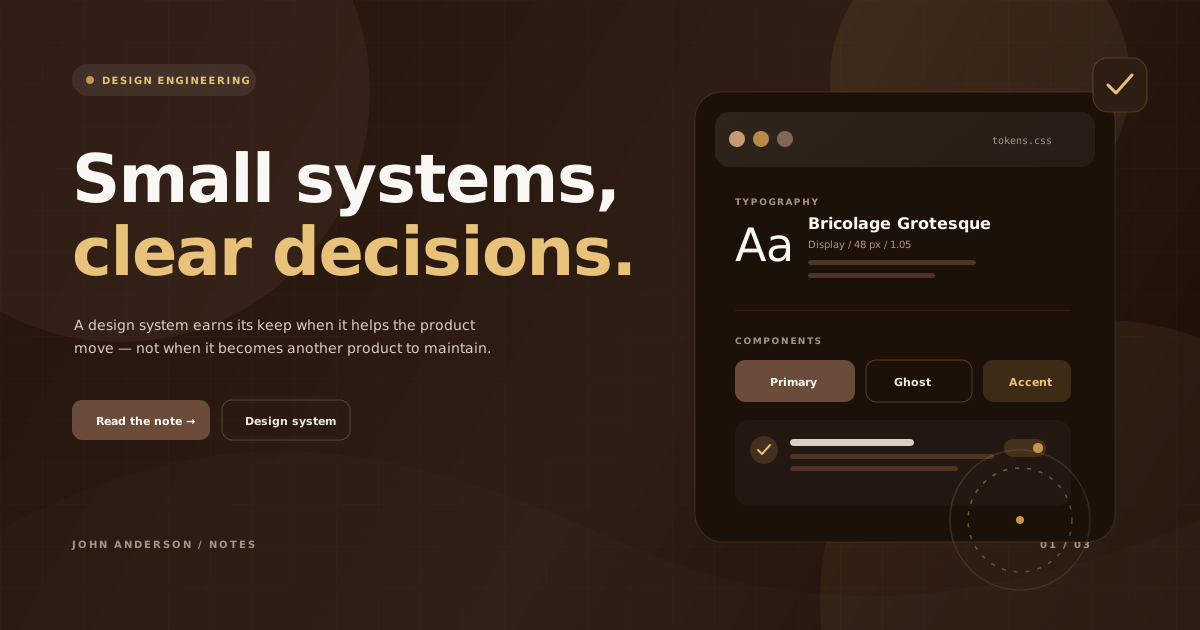
Most design systems do not fail because they are too simple. They fail because they keep growing after the original problem has been solved. The useful version is smaller, stricter and a little boring.
Start with the decisions, not the components
A component library is an output. The valuable input is a shared set of decisions: how spacing works, which type sizes exist, what a focus state looks like, when a surface should have a border instead of a shadow. If those decisions are clear, a small number of primitives can cover a surprising amount of product surface.
Before adding a new component, I ask what decision it encodes. If the answer is only this one screen, it belongs in the product, not the system. That single question prevents most of the accidental complexity that makes a system hard to maintain.
Keep the primitives honest
The primitives should be the things that are genuinely stable: layout, type, colour, spacing, focus, motion. Product-specific patterns can compose them. A pricing table, a dashboard card and a checkout summary should not all need their own entry in the system if they share the same underlying rules.
- Use tokens for decisions that repeat, not for every value in Figma.
- Give components one clear job and a narrow API.
- Document the awkward cases: empty, loading, error and long content.
- Delete components that no longer have a consumer.
Treat documentation as part of the interface
A component is not finished when it renders. It is finished when the next person can choose it confidently. That means a short usage note, a visible code example and a clear statement of what the component does not handle. Documentation does not need to be a separate website; a well-commented source file and a small showcase page are often enough.
The best design system is the one the team can still understand after the person who built it has moved on.
A working principle
Measure by friction removed
It is tempting to measure a system by adoption or component count. Those numbers can grow while the team still makes the same decisions from scratch. I prefer a simpler measure: what recurring questions disappeared? When spacing, focus states and responsive behaviour stop being debates, the system is doing its job.
Small systems are not less ambitious. They are designed to stay useful. A small system with clear rules is easier to extend than a large one with unclear ownership, and it leaves more room for the product to change.