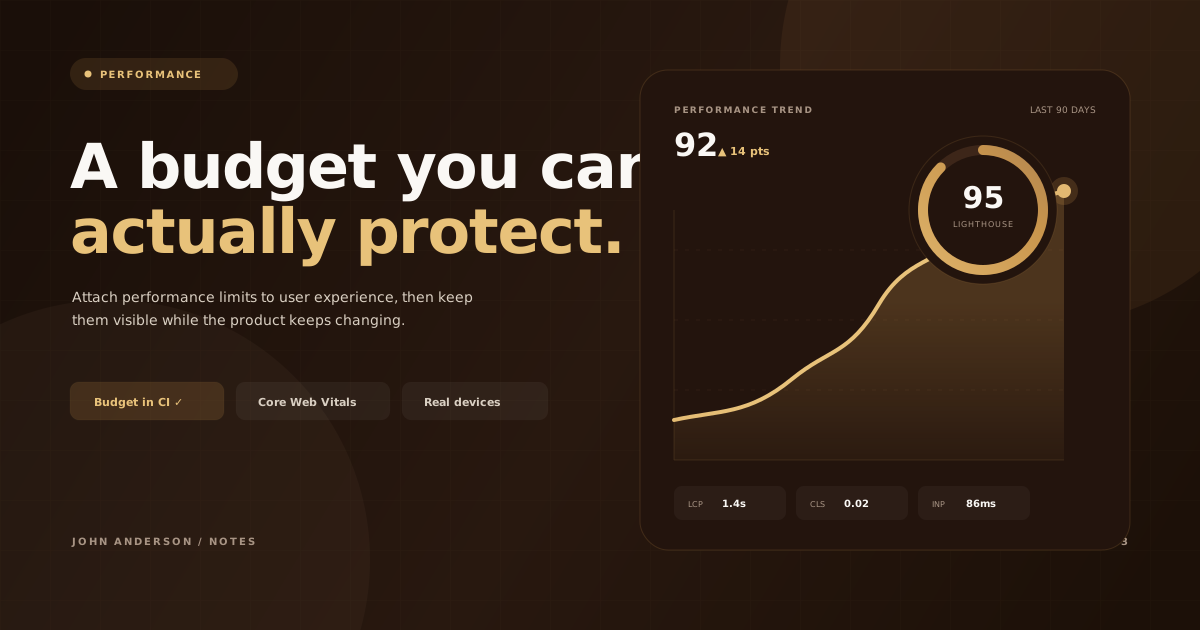
A performance budget is only useful if it changes a decision. A number nobody checks is a wish. The version that works is small, visible and tied to the experience you are trying to protect.
Start with the reading experience
For a content site, the critical journey is simple: open a page, understand what it is, start reading. Everything else is secondary. I set budgets around that journey first: how quickly the page can render readable text, how much the layout moves while loading, and how quickly the main thread becomes available for interaction.
- A useful first render on a mid-range phone, not a developer laptop.
- No image should cause a visible layout shift.
- Fonts should not hide the content for long enough to matter.
- The page should remain usable when JavaScript fails or loads late.
Budget the expensive parts
It is more effective to budget categories than individual files. Images are usually the heaviest part of a content page, followed by fonts and third-party scripts. If the budget for images is explicit, a large hero image becomes a conversation rather than a surprise.
Make the budget visible
A budget only survives if it is part of the workflow. I add a lightweight check to the build or CI that reports page weight and counts of render-blocking resources. It does not need to fail every build at first. A visible report is often enough to keep the next change honest.
page: /projects
html: 18 kB
css: 24 kB
js: 31 kB
images: 420 kB (lazy below fold)
render-blocking requests: 1
Judge with real conditions
Lab numbers are useful for comparison, but they are not the experience. Check a representative phone, a slower network and a page that is not the home page. A blog article is often the real test: it has text, an image, navigation and perhaps a share control. If that page feels immediate, the foundation is probably healthy.
Performance is a product quality, not a one-time audit. The budget is how you keep it from quietly disappearing.
A working principle
The goal is not a perfect score. The goal is to protect the moments that matter: the page appears, the text is readable, and the interface responds. A budget that keeps those moments intact is doing its job.